Category: Testimonials
Categories
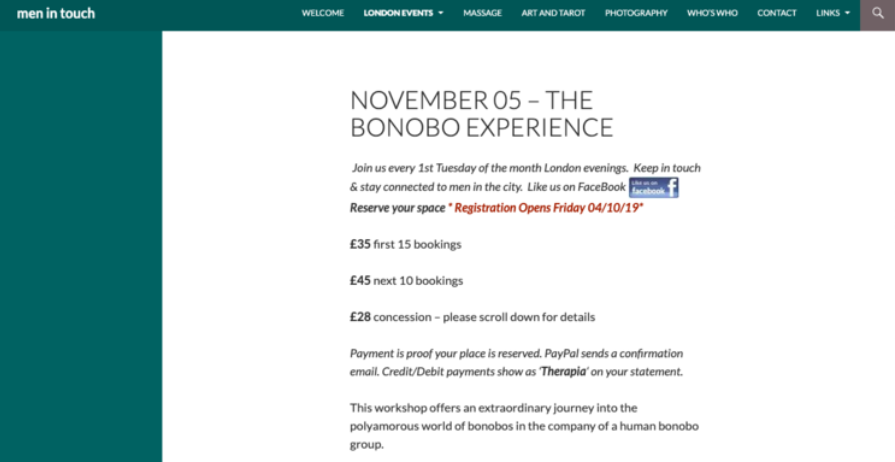
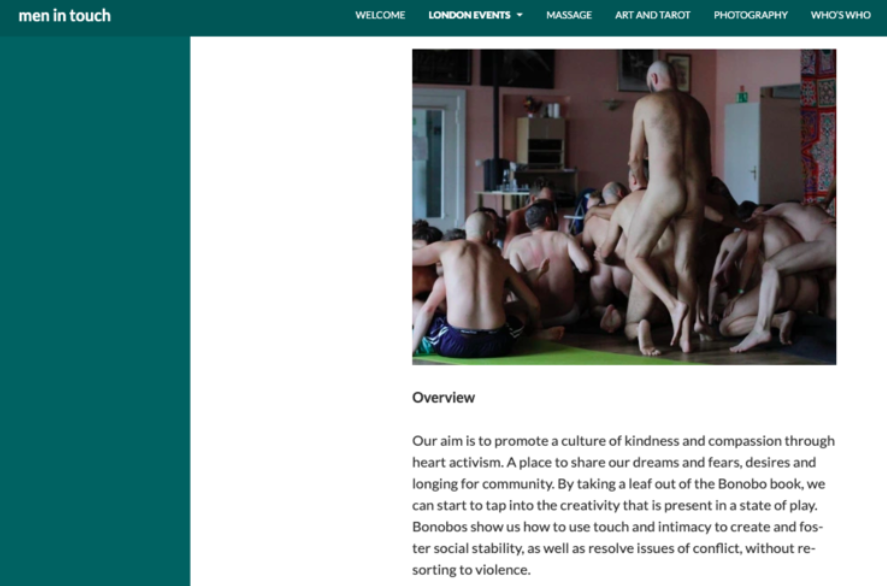
A glimpse inside a workshop
This is a very short glimpse into a workshop. Unfortunately we cannot film the various interventions as it turns the participants into actors and removes any change of authenticity.However this is a little example of the joy that happens.

Categories
Men In Touch feedback video
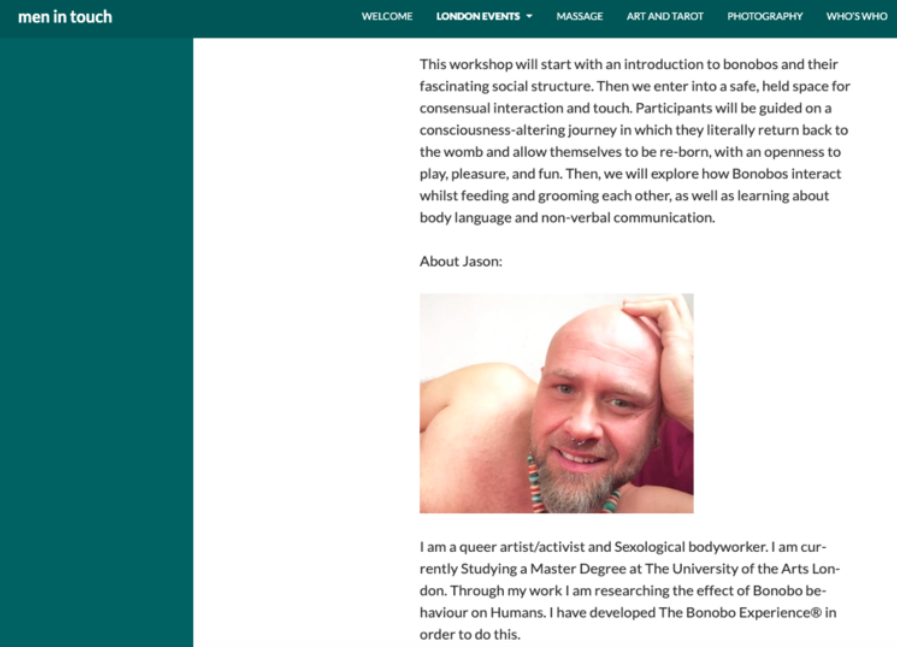
I first came across the bonobo experience in a work shop run at the stretch festival by Jason
This was a particularly strong and enjoyable experience for me as my first. There were monkeys selected and separated from the bonobos. I was in the bonobo group and stayed there throughout because I made particularly strong connections and it seemed a shame to break this up. The groups energy was very strong and at times I felt very much a part of this and sometimes in the centre. My lasting impression was fantastic. I put this mainly down to way it was presented. I left the workshop feeling elated and wholesome and wanted by others, so empowering.
Then my second experience was even more powerful and at times spiritual. I found the birthing ritual part particularly intimate and during the ritual I connected strongly mentally with my mother and the birthing experience she had with me. This is because 3 months before I was born there was an operation to remove some of her intestines which were strangling me and this was quite traumatic. So my eventual birth was watched by a dozen medical students. I related to this in the bonobo workshop and found it profoundly connecting with my own birth. I was very moved and this has helped me to connect with my mother even more empathetically.
The repetitive and faster sounds played during the routine really reinforced this
My third experience was less profound. I am not really sure why but after such an intense one the 2nd time perhaps this is to be expected. It was at the queer spirit festival and included outside space and I was less at ease and didn’t connect with the energy so easily
In summary I like the experience and would choose to have more because it helps me to really connect within myself and then have more authentic relationships with others

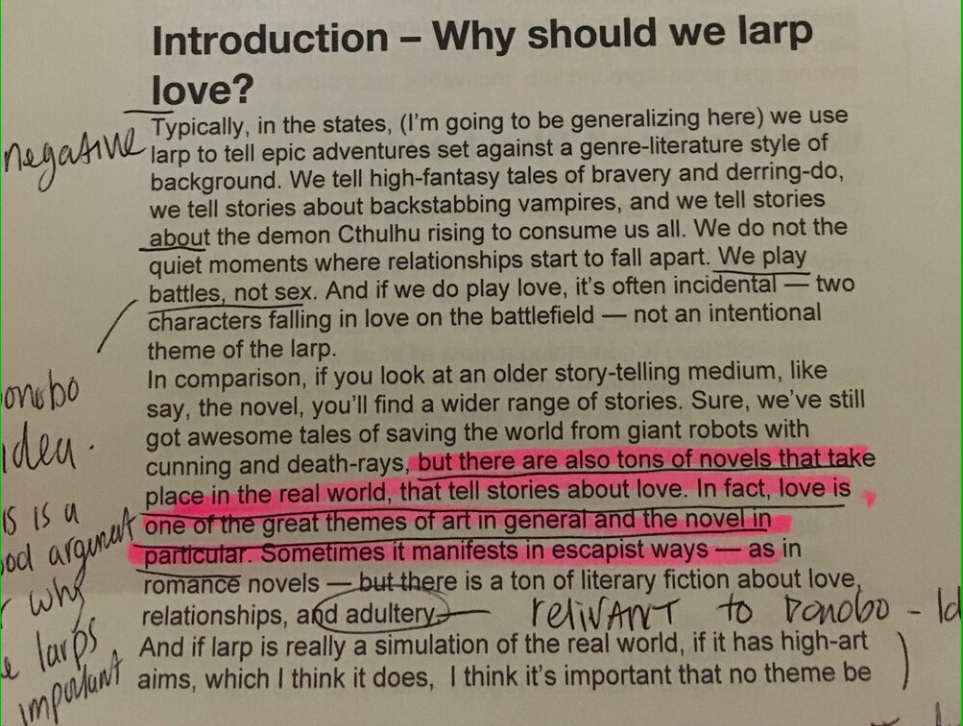
I am gathering my research for all of my workshops and I am re-visiting an old paper on love and sex in role-playing games. I have come across a piece of writing by Emma Wieslander. She is a Norwegian live-action role-play designer who is passionate about bringing love romance and sex into role-playing. I agree with her when she talks about how mainstream like matching role-play is predominantly dualistic black-and-white story that make strangers of ourselves and of others. Creating society is that only feel hatred in aggression is something that she worries about. The Banaba experience is very keen to build a live action role-playing attend compasses positive connection belonging and a deep sense of love.
The Banaba experience is very keen to build a live action role-playing between compasses positive connection belonging and a deep sense of love.
When she writes “I think it’s quite sad that many players should have a greater expectancy of their character getting killed them fucked. I also believe that there are stories that deserve to be told in their own right and not just as background information that contain love and intimacy.
I think it’s quite sad that many players should have a greater expectancy of their character getting killed them fucked. I also believe that there are stories that deserve to be told in their own right and not just as background information that contain love and intimacy.
I would be very interested in getting contact with this person to see if we can work together on the Bonobo Larp in the future
I enjoyed leading the birthing ritual at the Bonobo experience workshop in queer spirit 2019. It felt really good and also a honor to help people birth their own bonobo. I believe it is a very special moment of the workshop because it gives the space for people to use their imagination and connect with their primal selves. Who would we be if we were just born today in the jungle? I believe it is deeply healing for our human hearts to do this exercise. To remember that we are born on this beautiful planet, to remember our animal instinct and our human nature. To be reminded of our connection to nature and community. To feel like we belong. To communicate with each others in ways we haven’t explored before. The way we are raised in this society is so limiting and brain washing. We can feel so disconnected, alone and lost. We have to follow society standards that can be toxic and harmful. I believe so much in the work of the bonobo experience because it is not only fun and playful, it is deeply healing and awakening. I think that as humans we can learn from the bonobos.
Before leading the birthing ritual, I have participated in a few birthing rituals myself as an assistant or participant. I remember feeling very strong in one and rather than being the baby bonobo, I felt like I was the mother and ready to take care and hold the younger ones in the community. One other time, I just had so much fun connecting to the most raw and primal part of me. I also had another experience where I felt like my birth was difficult and I felt like I was alone. This is the proof that the birthing ritual can have many layers and go different ways for people. There is no right or wrong experience, I think all of them can heal or awaken deep parts within us.
Categories
A request for feedback
Among our two closest phylogenetic relatives, chimpanzees remain by far the more thoroughly-studied and widely-recognized species, known for their high levels of cooperation especially among males, which includes sharing food, supporting each other in aggressive conflicts and defending their territories against other communities. In contrast, insights into the social dynamics of wild bonobos are available from only a small number of long-term field sites, and bonobos are probably best known for their diverse sexual behavior, which together with their proposed peacefulness between communities and co-dominance between the sexes, has led to their nickname as the ‘hippie apes.”
The stereotype of bonobos as hyper-sexual is an over-simplification, but it does capture a fascinating aspect of bonobo social behavior. Bonobos are one of the few species in which all adult members of one sex engage in habitual same-sex sexual interactions that occur at similar or even greater frequencies as opposite-sex interactions. In the wild, all adult females perform same-sex genital contacts, known as genito-genital rubbing (or GG-rubbing) on a regular basis with many other femalesin their community. In contrast, male bonobos rarely engage in same-sex sexual behavior. There are several theories to explain the function of same-sex sexual behavior in bonobos, including as a way to reduce social tension, prevent aggression or form social bonds. However, none of these theories can explain why such behavior occurs so frequently only among females.
To clarify why same-sex sexual behavior is so important specifically for female bonobos, we collected behavioral and hormonal data for over a year from all adult members of a habituated bonobo community at the long-term LuiKotale field site in the Democratic Republic of Congo. In addition to our focus on sexual interactions, we identified preferred partners for other social activities such as giving support in conflicts. We also collected urine to measure the hormone oxytocin, which is released in the body in other species after friendly social interactions, including sex and helps to promote cooperation.
We found that in competitive situations, females preferred to have sex with other females rather than with males. After sex, females often remained closer to each other than did mixed sex pairs, and females had measurable increases in urinary oxytocin following sex with females, but not following sex with males. Among same-sex and opposite-sex pairs, individuals who had more sex also supported each other more often in conflicts, but the majority of these coalitions were formed among females. “It may be that a greater motivation for cooperation among females, mediated physiologically by oxytocin, is the key to understanding how females attain high dominance ranks in bonobo society,” explained co-lead author Martin Surbeck, a researcher at the Max Planck Institute for Evolutionary Anthropology and Harvard University.
For humans as well, alliances between members of the same sex provide many benefits, including mutual social support and sharing of resources. There is also historical and cross-cultural evidence that such alliances are often reinforced through sexual interactions. “While it is important to not equate human homosexuality with same-sex sexual behavior in animals,” cautions co-lead author Liza Moscovice, a researcher at the Leibniz Institute for Farm Animal Biology, “our study suggests that in both humans and a close phylogenetic relative, the evolution of same-sex sexual behavior may have provided new pathways to promote high levels of cooperation.”
More information: Liza R. Moscovice et al, The cooperative sex: Sexual interactions among female bonobos are linked to increases in oxytocin, proximity and coalitions, Hormones and Behavior (2019). DOI: 10.1016/j.yhbeh.2019.104581
Journal information: Hormones and Behavior
Provided by Max Planck Society
Thanks Jason. That was really interesting. I wonder if you have any information about why they do it. What’s there motivation? Is it to build stronger social bonds or maybe that is a secondary consequence, maybe there initial motivation is sexual gratification. Forgive me for saying it but that would be my first port of call judging by what we know about human behaviour?
Reply
Rob Lindsey-Clark because Bonobo society is a matriarch, the females need to maintain a sisterhood. Because they are more sexually active with one another over the males, levels of oxytocin (The bonding hormone) are higher among females, this makes them favour females and will protect one another over a challenging male. Males have plenty of sex but don’t form allegiances with other males. This is because female mothers keep their male offspring very close.(to avoid a patriarch uprising) Also because bonobos don’t pair bond, there is no father/son dynamic, unlike all another primate. In our culture, Males want to replicate themselves and avoid emasculating boys by avoiding very strong mother son relationships. Hope that helps.
Categories
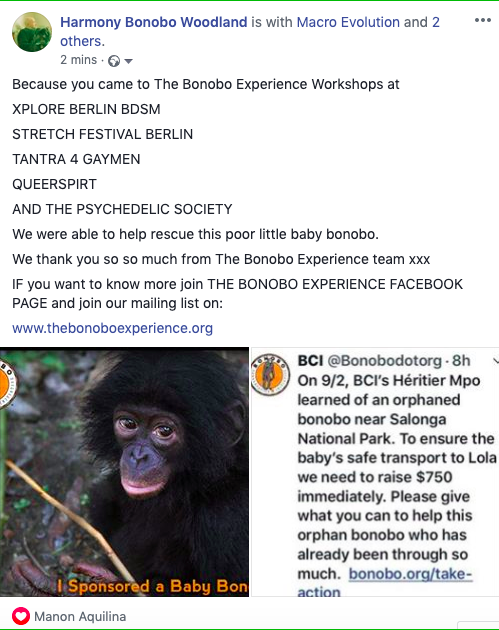
You helped save a Bonobo
Eye-opening results
The research team compared the darkness of the sclerae contrasted with irises of over 150 humans, bonobos and chimpanzees. The researchers found that bonobos, like humans, have paler sclerae and darker irises. Chimpanzees were found to have a different pattern — with very dark sclerae, and paler irises. Both of these colour patterns show the same type of contrast seen in human eyes, and could help other apes find out where they are looking.
“Humans are unique in many ways, as no other animal can communicate with similar intricate language or build tools of such complexity. Gaze following is an important component of many behaviours that are thought to be characteristically human, so our findings suggest that apes might also engage in these behaviours,” said Mr Perea-García.
Doctoral student Mr Juan O. Perea-García (front) and Associate Professor Antónia Monteiro (back) from NUS Biological Sciences suggest that apes may follow each other’s gaze like humans
.
n able to say, “Look over there!”. However, a look in the direction of the predator might be sufficient, as long as it was possible to follow the direction of their gaze.
Apart from helping us understand how our ancestors communicated, this study suggests some interesting new research directions. These include questions pertaining to why human beings and bonobos evolve in a similar way, despite bonobos being more closely related to chimpanzees.
Doctoral student Mr Juan O. Perea-García (front) and Associate Professor Antónia Monteiro (back) from NUS Biological Sciences suggest that apes may follow each other’s gaze like humans
Furthering our ancestral understanding
Before humans had language, our ancestors might have used the gaze of those around them to help communicate dangers or other useful information. They might not have been able to say, “Look over there!”. However, a look in the direction of the predator might be sufficient, as long as it was possible to follow the direction of their gaze.
Apart from helping us understand how our ancestors communicated, this study suggests some interesting new research directions. These include questions pertaining to why human beings and bonobos evolve in a similar way, despite bonobos being more closely related to chimpanzees.
My response
This is very exciting research and will go towards developing house sign language workshop. Allowing participants to engage in direction gazing and raising their awareness of this skill that is probably unknown to them could harness new abilities .It is encouraging to know that researchers are finding even more behaviours and evolutionary similarities.
 Bonobo Experience