Category: Testimonials
Categories
Oxytocin is natural ecstasy
Oxytocin, a hypothalamic nonapeptide, is linked to increased levels of social interaction, well-being and anti-stress effects.
The effects of oxytocin that is released by sensory stimulation during different kinds of interactive behaviors are often underestimated or even forgotten. In fact, many of the positive effects caused during interaction, such a wellbeing, stress reduction and even health promotion, are indeed linked to oxytocin released in response to activation of various types of sensory nerves.
JASON NOTES,
This has been spoken about in my workshops and we now use touch and affection to raise the level in oxytocin for participants
Oxytocin is released in response to activation of sensory nerves during labor, breastfeeding and sexual activity. In addition oxytocin is released in response to low intensity stimulation of the skin, e.g., in response to touch, stroking, warm temperature, etc. Consequently oxytocin is not only released during interaction between mothers and infants, but also during positive interaction between adults or between humans and animals. Finally oxytocin is also released in response to suckling and food intake. Oxytocin released in the brain in response to sensory stimulation as a consequence of these types of interactive behaviors, contributes to every day wellbeing and ability to handle stress. Food intake or sex may be used or even abused to achieve oxytocin-linked wellbeing and stress relief to compensate for lack of good relationships or when the levels of anxiety are high. The present review article will summarize the role played by oxytocin released by sensory (in particular somatosensory) stimulation, during various kinds of interactive behaviors. Also the fact that the anti-stress effects of oxytocin are particularly strong when oxytocin is released in response to “low intensity” stimulation of the skin will be highlighted.
INTRODUCTION
Human individuals express different behaviors in order to feel well and to avoid tension and stress. Some of these behaviors are maladaptive and could be regarded as expressions of abuse, whereas others clearly represent healthy and natural ways of achieving every day wellbeing and relief from stress. A common denominator of several of the natural “soothing mechanisms” is that they often involve some type of sensory stimulation of skin or mucosa. Oxytocin, released within the brain from oxytocinergic nerves emanating from the paraventricular nucleus (PVN) in response to such sensory stimuli, is of crucial importance for the positive effects linked to these self-soothing behaviors (Buijs, 1983; Buijs et al., 1983; Sofroniew, 1983; Uvnäs-Moberg, 1998).
Jasons notes
Participants describe how the feel much more connected and relaxed once the have connected with others through grooming.
Categories
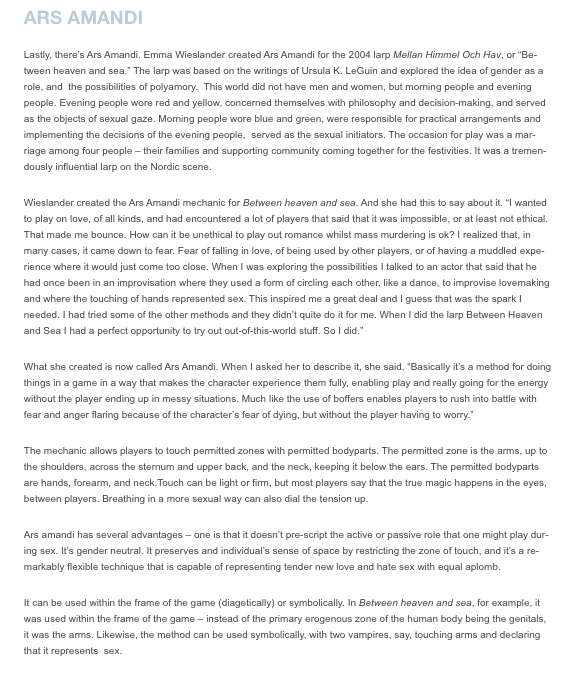
Sex in Live Action Role Play (LARP)


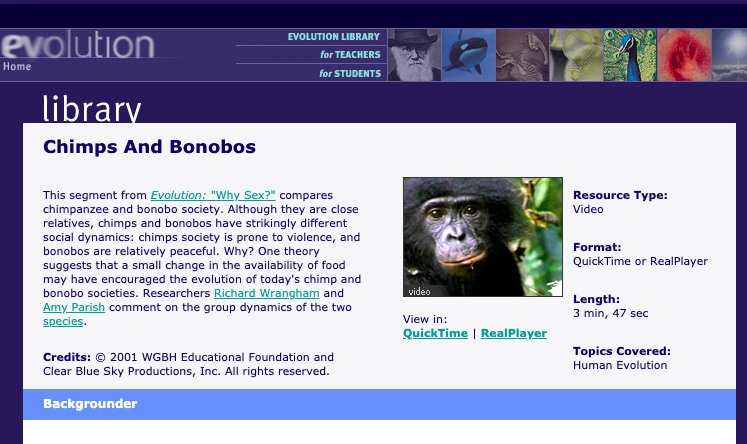
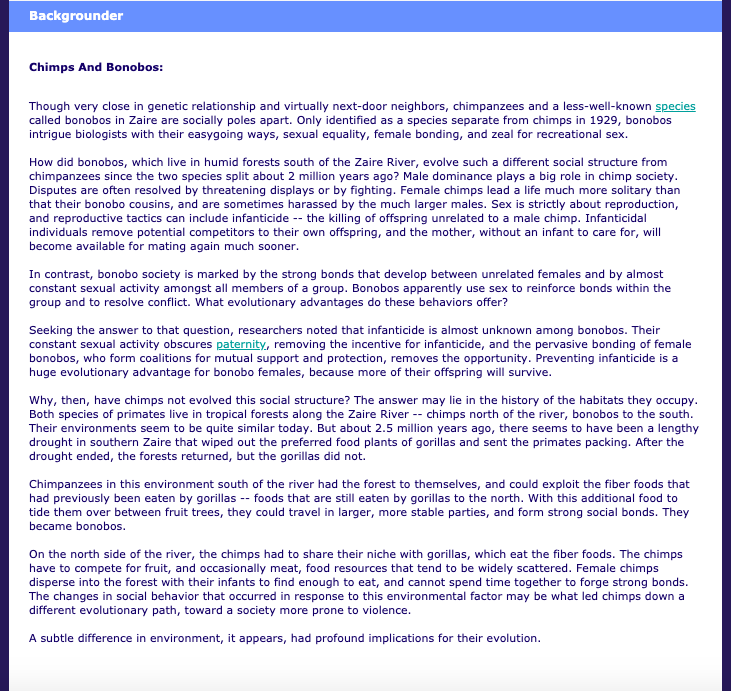
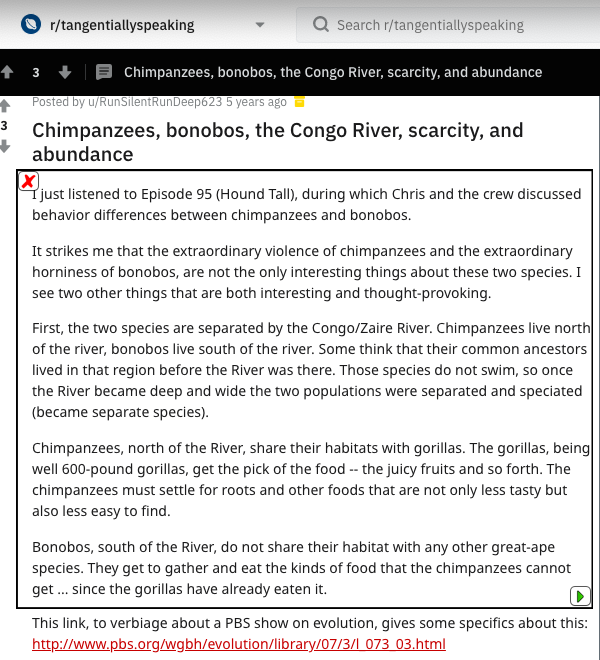
This is why bonobos evolved with a female lead. There is food in abundance so there was no need to fight for it like the Gorillas and the Chimps who are separated from the bonobos’ by the Congo river.

Categories
Emotional Intelligence
In two separate incidences in the same day I have learnt about my own self-awareness. In a book called the forgotten Ape, I read a term called personal psychological feedback. This had a immediate psychological feedback experience for me. Reading it did it, I reformed the loop of feedback there and then.t. And now listening to the four pillars of emotional intelligence I realise how deliberate I have been in ignoring my own psychological feedback. This makes me very sad because I have denied or sabotaged my own Self in order to pretend to be somebody else. This is personal and around my sexuality so I won’t allude to it here. But this awareness of psychological feedback is both profound and upsetting.
Categories
Sign language bonobo style
INTERACTIVE NON VERBLE COMMUNICATION GAME VERY WELL RECEIVED WILL USE FOR LIVE ACTION ROLE PLAY AND RETREATS
I’m thinking about the course and the bonobo experience, because we have a workshop this evening at Men in Touch massage. It got me thinking about where the project wants to go after this MA ?
I am thinking like this because I don’t want the abrupt end to the project or a come down that can happen to me post education. So in order to maintain my wellbeing I want to propel the work forward in a psychological sense to guard against this.
I’m considering what it is that I’ve done and I’ve come to the conclusion that I have in fact developed a series of workshops, which could develop into Modules.
This is a resource that can help other people on the team run the bonobo experience. The extensive videos journals and feedback interviews plus the workshops and their schedules, feedback and analysis all provide a map to the bonobo experience and its future development.
The Bonobo Experience course is where people can learn a variety of skills that enable community cohesion. Perhaps we would run a bonobo experience retreat that focused on intimacy and have discussion around that. Our focus could also be polyamory and its wider benefits to community. For the Motherhood we could talk about bereavement and how to deal with death in community.
The chimps versus bonobos theme of conflict resolution may be something that we could integrate. We could hire experts who do training around nonviolent communication or intimacy in polyamorous relationships. Any number of themes could be up for discussion at The Bonobo Experience. In essence this has been my thinking today about what next is beyond the course.
Was great after people got relaxed and able to connect with one another. A learning for me was that these men had just finished work and we not in a festival. Therefore they we very timid about the playfulness of the content. Then however we had to slow them down because it moved into a very sexual space that we had not accounted for. It was very hard to get them to respond to our program after that. If we run it again we could move more into the sexual. Or we could craft a better massage workshop.
Food sharing in bonobos: Tolerant sharing in a despotic society
The study of food sharing in apes can provide an interesting perspective on the evolution of altruism in early hominids. Sharing food can be an altruistic behaviour, entailing costs to food-owners and benefits to others,, but several alternative hypotheses have been proposed. For example, when food is shared between kin, kinship selection is at play. Chimpanzees often share food under pressure of their group members (harassment hypothesis). The reciprocal altruism hypothesis assumes that apes use mental bookkeeping: they may remember who groomed them and reward grooming effort by access to food, possibly following predictions of biological market models. Alternatively, apes could share food based on simple rules of thumb by sharing mostly with group members that are most similar to them (similarity hypothesis). Previous studies have focussed mainly on chimpanzees, and studies on bonobos are rare and often more descriptive. Moreover, different studies differ in kinds of food offered to the apes, in definitions used to describe patterns of food sharing, and in type of analysis. Here we used a test paradigm previously used for bonobos and chimpanzees in a new group of bonobos at Planckendael Wild Animal Park, Belgium. The first author studied the group of 6 adult and 2 immature bonobos for 295 hours in August and September 2010. First, bonobos were observed under standard feeding regime, with four feedings per day and no attempts to induce food sharing. Second, food was provided in large paper bags twice a day. Third, large bundles of willow were provided daily in addition to normal feeding regimes. Our results show that the dominance hierarchy in this group was very linear and strict. In contrast to expectations based on previous research, food sharing was very tolerant, with mostly relaxed food transfers, and no negative responses of food owners to approachers. This finding argues against the “harassment hypothesis”. Food sharing was however influenced by kinship: kin shared more frequently and more successfully than non-kin. In line with expectations of the biological market models for despotic groups, food was not exchanged reciprocally, but bonobos gave more food to group members that groomed them longer. In conclusion, we found that bonobos share more with group members that groom them longer as expected by biological market theory. However, sharing was more tolerant than previously reported, and it was influenced by kinship. This may be due to differences in group composition and/or personalities of the individuals involved in the study, effects that are possibly enlarged by small sample sizes.
RESPONDING TO BOLD TEXT It is really encouraging to learn that bonobos don’t fight and share food openly. That also share more with others that groom them.
 Bonobo Experience